
Persistence of Gendered Violence | OP-ED | Security Lense | 25-July-2025
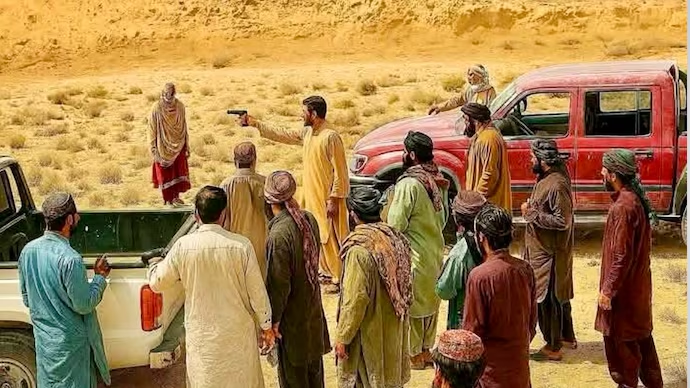
The recent execution of a woman in Baluchistan for being in a consensual relationship another example of how Pakistan’s legal and social systems are deeply dominated by patriarchal attitudes and damaging cultural norms. Even in the 21st century, tribal decisions can become the matter of life and death for people.
These kinds of homicides, which are often called “honor crimes,” are really about keeping control, masculine supremacy, and tribe authority. In places where tribal conventions are more important than the law, those who go against these rules are not only punished, but they are also made examples. These actions show more than just cultural backwardness; they also show how state institutions have not been able to establish legal power in places where tribal law is still in charge.
The fact that women are still married off to settle conflicts, like in Vani and Swara, shows how women’s bodies are utilized to protect so-called honor. This article looks at how traditions, lack of political action, and societal conditioning keep a system running where violence against women is acceptable and freedom is seen as disobedience.
Vani and Swara: Tools of Punishment, Not Justice
Vani and Swara are not forms of justice; they are ways for men to control women that come from patriarchal culture. These traditions are sometimes employed to “make up” for misdeeds perpetrated by men in the family, but the women and girls are the ones who have to deal with the consequences. In both cases, women are not seen as people with rights, but as something to trade and punish.
A woman was killed in Balochistan for exercising her basic freedom to pick her mate, a right that was taken away from her since it went against tribal standards. Like Vani and Swara, her punishment wasn’t based on guilt, but on the idea that women needed to be kept in line and “honor” needed to be maintained through their enslavement.
These rituals have a big effect on people’s minds and lives. Girls who grow up in these kinds of homes are scared, can’t make their own choices, or find happiness. They learn to be quiet and submit as a way to survive.
Jirgas and the Collapse of State Power
The Supreme Court has said that jirgas are unlawful, yet they are nevertheless used in many parts of Pakistan. This is mostly because they may quickly solve problems in a system where regular courts are known for being slow and hard to reach.
People in rural and tribal areas frequently trust these traditional systems more than the state’s legal system because they get results right away instead of having to wait for the courts to go through all the red tape. Jirgas could work if they were based on reason and fairness, but many have turned into places where extremely patriarchal and regressive choices are enforced, especially against women.
Because the state hasn’t set up a reliable and timely justice system, jirgas are still filling the gap. The recent Balochistan case, in which a jirga is said to have ordered the woman’s execution, shows that these parallel structures are still around and that the state is not doing anything to stop them. The killers acted without fear, and it’s said that they even filmed and released the footage themselves.
This is a harsh truth: in areas where tribal codes are in charge, the state has no influence. In some circumstances, the state is not missing by accident; it is missing on purpose. The event makes it clear that the state is dead; long live the state.
The pattern in cases like the recent one, Qandeel Baloch’s, and Farzana Parveen’s shows a disturbing truth. In each case, women were punished for making personal decisions that went against male authority. People in power, whether they are a brother, father, or tribal council, typically don’t see women as people with rights and freedom. Instead, they see them as property that must follow family or social rules.
This false sense of ownership is a big part of violence based on honor. There was a lot of outrage around the world after Qandeel Baloch was killed in 2016 and Farzana Parveen was brutally killed outside the Lahore High Court in 2014, but legal changes haven’t made much of a difference. The same kinds of violence keep happening, and recent events illustrate that women can still be slain without punishment.
When people commit these kinds of crimes in public, video them, and even brag about them, it shows how violence is becoming acceptable. These headlines are no longer alarming to many women; they are daily reminders that their lives depend on following the rules. dread has grown so normal that it doesn’t feel like dread anymore; it feels like survival.
Gendered Violence and the Myth of Honor
In societies that are very patriarchal, the idea of honor is mostly and unfairly given to women. People often see girls as a burden, yet they raise boys to be leaders and carry on their families’ traditions. In cases like the recent Balochistan event, where both the male and woman died, the woman’s actions are shown to be the worse threat to social order.
Society is afraid that when women stand up for their rights, they will challenge long-standing power structures and fight for the rights that have been denied to them in the past. Honor becomes a tool of control; it has nothing to do with morality and everything to do with power. As a result, women all around the country, including those in more supportive environments, continue to feel a low level of fear.
Their family aren’t the sole source of their concern; they also live in a society where violence against women is rampant and justice is rare. This dread slowly lowers confidence, limits independence, and makes silence the only way to stay alive.
The Politics of Silence and Media Forgetfulness
Politicians may make statements following incidences of gendered violence, but these answers are generally just for show and don’t really change anything. In tribal areas, political leaders have little influence against the dominating jirgas and local power structures, which not only resist state intervention but also work to stop it.
Because of this, leaders talk to be seen, not to be fair. In the same way, law enforcement is still not effective in certain situations, when tribal norms take precedence over the Constitution. Police personnel can’t or won’t protect women who go against the norm because of the same cultural mindset or because of unwritten rules. At first, there is a lot of media coverage, but it gradually disappears.
In cases like Noor Mukaddam’s and the latest murders in Balochistan, people may get angry for a short time, but these events rarely lead to enduring changes in institutions. There needs to be a complete change in the way people think about things, and social media campaigns, hashtags, and discussion programs can’t do it. These patterns of gendered Violence will keep happening, no matter who talks about them or reports them, until boys are raised differently and people at all levels of society stop following old rules.
In many parts of Pakistan, women are still treated as liabilities—objects that can be negotiated, punished, or sacrificed to uphold cultural traditions. Even in the 21st century, the right to choose one’s partner or live freely remains a risk for many women. While each case of violence sparks brief media attention and online outrage, these stories are quickly replaced by newer tragedies, often more brutal than the last. And yet, there are glimmers of hope.
A growing number of young men are beginning to unlearn toxic ideas of masculinity and control. But for real change to occur, structural reforms must be paired with cultural transformation. Mothers must raise boys differently. Elders must be challenged with dialogue.
The state and tribal leaders must finally confront each other over what justice should mean in a modern society. Above all, women must be treated as full human beings—capable of choice, feeling, and freedom. And perhaps the most urgent message is this: be kind to the women around you. Support them. Listen to them. Because you never know what someone else is fighting for just to survive.
Connect with Security Lense

Leave a Reply